If you searched for website trends 2025 last year, you probably saw a lot of bold predictions and flashy visuals, and phrases like “the future of digital”. We saw those too.
Meanwhile, the conversations we were having told a different story.
Instead of asking what was new or flashy, prospects and clients were asking what worked. They asked smarter questions. They cared about usability, accessibility, security, and control. They wanted sites that loaded fast, made sense to users, and did not require a developer on speed dial for every update.
Let’s reflect on the 2025 website trends we actually saw, based on real conversations across web design, development, and digital marketing.
1. AI Became a Practical Question, not a Buzzword
AI was everywhere in 2025, just not in the way people expected. Instead of asking if they should use AI, prospects asked how
it would help their website.
That shift became noticeable in the second half of 2025, when the novelty wore off and expectations got sharper.
Common questions include:
- Does AI improve website search results?
- Yes, when implemented intentionally and paired with clean content and structure.
- What are best practices for AI personalization in websites?
- Use AI to support UX, not overwhelm it. Less automation and more relevance.
- How do you use AI on a website without hurting user experience?
- By enhancing navigation and discovery, not replacing human judgment.
The vibe shifted quickly. AI stopped being a headline feature and started becoming infrastructure. It was less about showing it off and more about using it well.
This was a big moment. AI only mattered if it made the experience better. If it slowed things down or made content feel generic, it was a hard pass. Our research found that that overusing AI to generate content was part of the problem. When everything starts to sound the same, standing out suddenly matters a lot more.
If you’re thinking about how this applies to your own site, we go deeper in our blog on how to prepare your website content for AI searches.
Going into 2026, we’re focused on using AI where it adds real value and pulling back where it starts to dilute clarity, usability, or originality.
2. CMS Control and Flexibility Mattered More Than Ever
Control came up a lot in 2025. Specifically, post-launch control.
Clients wanted to understand what day-to-day life looked like once the site was live. They were thinking past go-live and into year two.
Some common questions:
- Can we update content without calling a developer every time?
- How flexible is the CMS long term?
- Antilles is highly customizable and built to scale.
- How does this compare to open-source platforms like WordPress?
The conversation shifted away from just building a website to living with it. Flexibility, scalability, and third-party integrations became top priorities.
(Time for a brief shameless plug) This is where purpose-built CMS platforms like Antilles CMS started to make more sense. Teams wanted real control without turning their website into a patchwork of plugins and workarounds.
In other words, less duct tape, and fewer “why is this broken?” moments.
3. Accessibility Was No Longer Optional
Accessibility stopped being an add-on in 2025. It became a baseline expectation across industries.
Prospects and clients asked about:
- ADA and WCGA compliance
- Accessibility standards are addressed during build, not after.
- Accessibility best practices
- How accessibility impacts real users
- It improves usability for everyone, not just edge cases.
.png) Request a Free Accessibility Scan
Request a Free Accessibility ScanThe mindset shifted. Accessibility became part of good design, not risk management. Clear structure, readable content, and intuitive navigation helped everyone. Accessibility is built into every project we take on at Web Solutions, not tacked on at the end. We also offer ongoing accessibility services, which are becoming more important as standards, expectations, and regulations continue to evolve in 2026.
4. Security and Hosting Became a Peace of Mind
Security was one of the most common concerns we heard in 2025, especially from organizations handling sensitive data.
The questions were practical:
- Where are backups stored?
- Off-site, encrypted, and regularly tested so recovery is fast and reliable.
- Who handles security updates?
- Our team manages updates and monitoring to reduce risk and catch issues early.
- How secure is the hosting environment?
- Built with industry best practices and ongoing oversight.
What people really wanted was peace of mind.
Secure hosting, reliable backups, and clear ownership all became core parts of website planning. Security and uptime continue to be a top priority in how we approach website development at LRS Web Solutions. If you’re curious what that looks like in practice, we break it down in our How Secure Is My Website? blog post.
5. Design Trends Shifted Toward Clarity and Personality
Minimalism did not disappear in 2025, but the reason it stuck around changed.
For a long time, clean design dominated because it was faster to produce, easier to maintain, and safer to scale. Many teams leaned on minimal layouts because they worked, not because they were super exciting.
What changed in 2025 was not the look of websites, but the process behind them.
AI sped up design workflows and lowered the cost of iteration. Designers could explore more ideas, test variations faster, and push concepts further without blowing timelines or budgets.
Prospects asked for:
- Clean, modern layouts that did not feel generic
- Strong use of white space paired with more personality
- Real photos and custom visuals instead of stock imagery
But underneath those requests was a growing appetite for personality. Sites needed to feel intentional, not templated.
"Okay, but if everyone has access to the same AI tools, won’t everything just start to look the same?"
Yes. That’s exactly the risk. AI can help you make more, but it still can’t help you make better ideas. Read more about the human element in AI design.
6. Performance, SEO, and Mobile Experience Were Not Optional
Performance was no longer a bonus feature. It was expected.
Conversations consistently touched on:
- Faster load times
- SEO foundations built into the site
- Mobile usability as a priority, not an afterthought
SEO stopped living in its own lane. It became part of the foundation, right alongside design and development. Mobile-first thinking became the norm. Want to check if your site is mobile-friendly? Take our super short quiz.
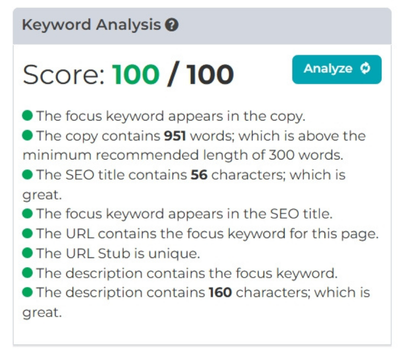 SEO insights built directly into Antilles CMS
If there’s one takeaway from all of this, it’s pretty simple.
The best website trends are not really trends. They’re expectations. And in 2025, those expectations got louder, clearer, and harder to ignore.
If your website still feels hard to manage, hard to use, or hard to trust, it’s usually a sign that the site hasn’t kept up with how people use the web today. At LRS Web Solutions, we focus on building websites that work today and continue to work long after launch.
Looking ahead to 2026, that focus doesn’t change.
We’re doubling down on the things clients keep telling us matter most: clarity, performance, security, accessibility, and tools that are actually usable day to day. Most importantly, we’ll keep listening closely, because the best improvements usually come straight from the people using the site, not from a trend report.
Want to see how your website stacks up against these 2025 trends? Contact us and let’s talk through what’s working, what’s not, and what could come next.